Corona sits in the Santa Ana River valley, where alluvial and older terrace deposits create a soil matrix that ranges from silty sands to clayey gravels. The dry summers and occasional heavy winter rains mean moisture conditions shift fast. Without a proper Proctor test, you risk designing compaction specs that don't match what the material can actually achieve. We run both Standard (ASTM D698) and Modified (ASTM D1557) Proctor tests right here in Corona, so the moisture-density relationship reflects your actual borrow source. Before you start moving dirt, pair the Proctor with a classification of soils to understand the full material behavior.
One wrong moisture assumption during compaction can turn a 95% relative density spec into a layer that settles under its own weight within months.
Methodology applied in Corona California
Typical technical challenges in Corona California
A common mistake we see in Corona is contractors running the Proctor on a single sample and assuming it applies to every borrow pit on the site. The alluvial soils change from one end of a lot to the other. If you don't test each distinct material type, you end up with compaction specs that are either too loose or impossible to reach. The result is differential settlement under slabs, cracked pavements, or failed retaining walls. We recommend one Proctor per soil type identified during the initial subsurface exploration. For large subdivisions, that often means 3 to 5 tests across the property.
Our services
We offer three Proctor-related services tailored to different project scales in Corona.
Standard Proctor (ASTM D698)
For residential slabs, sidewalks, and low-traffic pavements where the compaction effort matches typical construction equipment. We test your borrow material and deliver the moisture-density curve within 48 hours.
Modified Proctor (ASTM D1557)
For highway subgrades, airport fills, and heavy-load industrial floors. The higher compaction energy simulates heavy rollers and vibratory compactors. We run this when the design spec requires 95% relative compaction or higher.
Proctor + Field Density Verification
We combine the lab Proctor curve with in-place density tests using sand cone or nuclear gauge. This package gives you a complete compaction QA record for each lift placed on your Corona site.
Frequently asked questions
What is the difference between Standard and Modified Proctor tests?
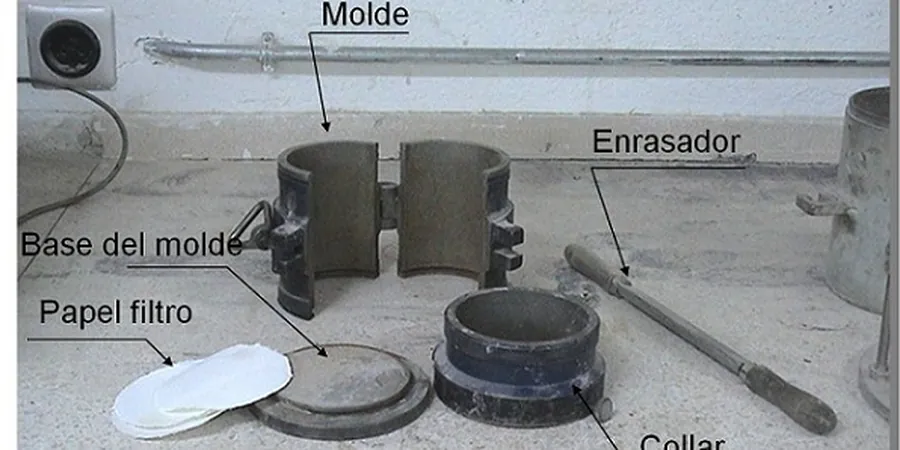
Standard Proctor uses a 5.5 lb hammer dropped 12 inches in 3 layers. Modified Proctor uses a 10 lb hammer dropped 18 inches in 5 layers, applying about 4.5 times more compaction energy. Choose Standard for light-traffic fills and residential work; choose Modified for highway bases, airport pavements, or any spec requiring high density.
How much does a Proctor test cost in Corona?
A Standard Proctor test typically runs between $90 and $150, while a Modified Proctor is $120 to $220. Prices vary with the number of points on the curve and whether you need a 4-inch or 6-inch mold. We can give you a firm quote once we know your material type and project scope.
How many Proctor tests do I need for my Corona project?
One Proctor per distinct soil type on your site. If your geotechnical report shows silty sand in one area and clayey gravel in another, you need two tests. For a typical single-family lot with uniform fill, one test usually suffices. We recommend reviewing the soil classification first to decide.