The alluvial fan deposits underlying much of Corona, California, consist of interbedded sands, silts, and gravels from the Santa Ana River system, with groundwater depths ranging from 3 to 9 meters depending on the season. This combination of loose granular soils and a shallow water table creates conditions where soil liquefaction analysis becomes critical for any mid- to large-scale development. We routinely evaluate blow counts from SPT soundings using the Youd-Idriss 2001 method, correlating directly with the NCEER workshop procedures. In our experience, a proper assessment begins with a detailed plan of borings spaced no more than 30 meters apart in plan, targeting the zones where cyclic resistance ratio may fall below the cyclic stress ratio under the design earthquake. Before mobilizing, we often recommend a resistivity survey to map lateral variability in saturation and fines content across the site.
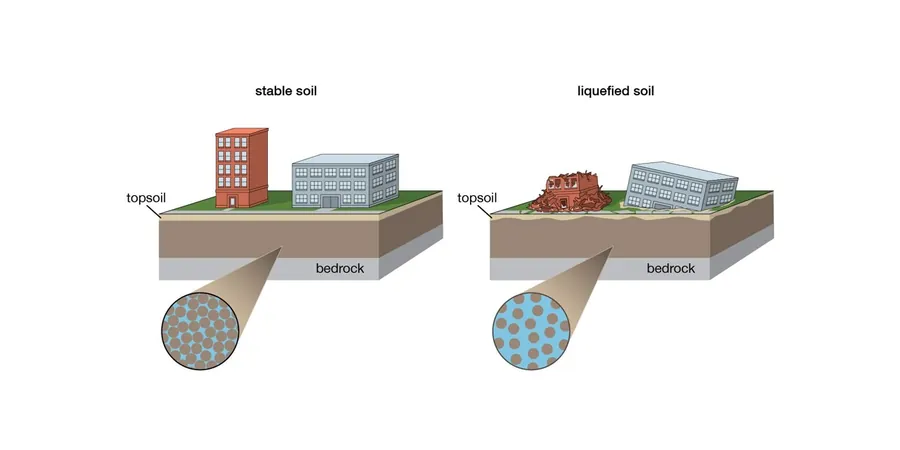
In Corona's alluvial sands, a factor of safety below 1.1 at Mw 7.5 means ground improvement is non-negotiable before footing placement.
Methodology applied in Corona California
- N-SPT values corrected for overburden and hammer energy (N1_60)
- Cyclic resistance ratio at Mw 7.5 and 6.5
- Factor of safety against liquefaction triggering
- Post-liquefaction settlement and lateral displacement
Typical technical challenges in Corona California
ASCE 7-22 requires site-specific soil liquefaction analysis for Seismic Design Categories D, E, and F, which applies to most of Corona given the proximity to the San Jacinto fault zone. The primary risk we encounter is not just triggering of liquefaction but the resulting lateral spreading along gentle slopes of 1-3 degrees, which can sever utility lines and shift shallow foundations several inches. Our reports quantify the post-liquefaction residual strength of the soil and the expected differential settlement between rigid elements like columns and the surrounding ground. In zones where the factor of safety falls below 1.0, we recommend ground densification or deep foundations extending below the liquefiable layer.
Our services
We offer a complete suite of field and laboratory testing services for liquefaction assessment in Corona, California.
SPT Borings with Energy Measurement
Standard Penetration Tests with automatic hammer energy calibration to N1_60, spaced per project needs and logged in real time.
Fines Content & Atterberg Limits
Wash sieve and hydrometer analysis per ASTM D7928 plus liquid and plastic limits per ASTM D4318 for fines classification.
Shear Wave Velocity (MASW)
Multi-channel Analysis of Surface Waves to determine Vs30 and site class per ASCE 7, covering large areas cost-effectively.
Liquefaction Potential Report
Comprehensive report including CRR/CSR curves, factor of safety profiles, settlement estimates, and mitigation recommendations.
Frequently asked questions
How is soil liquefaction analysis performed in Corona?
We drill SPT borings to 18-24 meters depth, measure hammer energy, classify soils in the field, and run fines content and Atterberg limits in the lab. The data is analyzed using the Youd-Idriss 2001 method to compute cyclic resistance ratio and factor of safety for the design earthquake.
What is the typical cost for a liquefaction study in Corona?
For a standard residential or commercial site with 3-5 borings, the cost ranges from US$2,760 to US$3,890. Larger developments with MASW coverage or deeper borings can exceed this range. We provide a fixed-price quote after reviewing the project scope.
Do all new buildings in Corona require liquefaction analysis?
Most structures in Seismic Design Category D or higher require site-specific analysis per ASCE 7. The Corona building department typically mandates it for projects with more than two stories or significant lateral loads. Check your site class and design category first.
What ground improvement methods work best for liquefiable soils in Corona?
Deep dynamic compaction and vibro-stone columns are common for granular layers up to 12 meters thick. For deeper deposits or sensitive sites, we often recommend driven piles or drilled shafts socketed into competent strata below the liquefiable zone. The choice depends on factor of safety profiles and cost.