A housing development on the foothills near the Santa Ana River in Corona California required a detailed debris flow analysis after a nearby wildfire stripped the slopes of vegetation. The geotechnical team needed to quantify potential flow volumes, runout distances, and impact forces on proposed retention basins before the city would issue building permits. We modeled the watershed using site-specific soil classification (ASTM D2487) and historical rainfall data. Before finalizing the analysis, we cross-referenced the results with a granulometry study to characterize the sediment size distribution in the alluvial fan deposits. This combined approach gave the developer clear design parameters for debris barriers and drainage infrastructure.
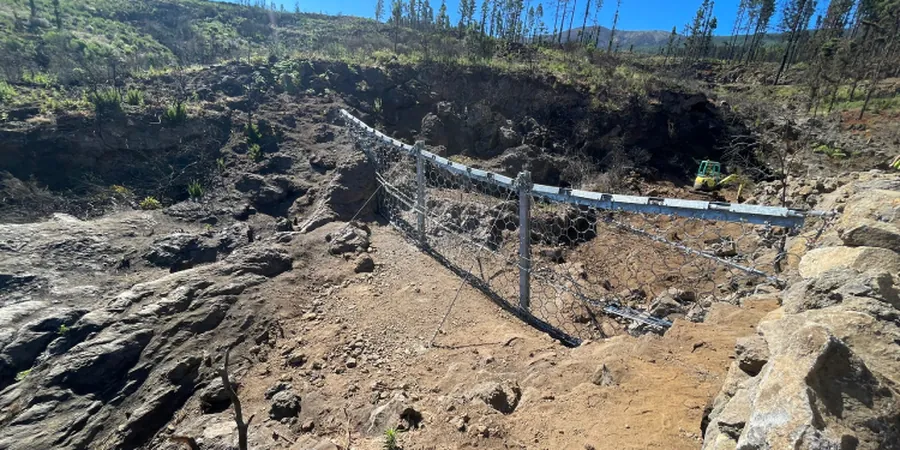
Post-fire debris flows can mobilize boulders exceeding 3 feet in diameter at velocities over 15 mph on slopes steeper than 30 percent.
Methodology applied in Corona California
Typical technical challenges in Corona California
Corona California expanded rapidly from the 1980s onward, with subdivisions climbing into the Santa Ana Mountains foothills. That growth brought development onto steep colluvial slopes and Holocene alluvial fans that had never been engineered for debris flow resistance. The 2018 Holy Fire scorched over 23,000 acres upstream of the city, and the following winter produced multiple debris flows that damaged roads and culverts in the Glen Ivy area. Without a site-specific debris flow analysis, a project built on those fans faces potential structural damage, blocked drainage, and liability for downstream flooding. The city now requires a quantitative hazard assessment for any new structure within mapped debris flow zones, referencing the 2022 California Geological Survey guidelines.
Our services
We offer two complementary debris flow analysis packages tailored to the specific conditions of Corona California.
Post-Fire Debris Flow Assessment
Rapid evaluation of burned watersheds using burn severity maps, rainfall intensity-duration thresholds, and sediment yield equations. Output includes runout distance, debris volume estimates, and recommended mitigation measures such as check dams or deflection walls. This service is typically completed within 10 business days.
Alluvial Fan Hazard Mapping
Detailed fan stability analysis for subdivision-scale projects. We combine historical aerial imagery, field reconnaissance, and 2D hydraulic modeling (FLO-2D) to delineate hazard zones. Deliverables include a debris flow inundation map, impact force calculations for individual lots, and foundation design recommendations per the 2022 California Building Code.
Frequently asked questions
What triggers a debris flow in Corona California?
Debris flows in Corona California are most often triggered by intense rainfall on steep slopes that have been burned by wildfire. The loss of vegetation and the formation of a water-repellent soil layer reduce infiltration, causing rapid runoff that mobilizes soil, rock, and organic material into a fast-moving slurry. Seismic shaking from earthquakes can also dislodge material on critical slopes.
How much does a debris flow analysis cost in Corona California?
The cost for a debris flow analysis in Corona California typically ranges from US$1,160 to US$4,340 depending on the watershed size, complexity of the terrain, and whether 2D hydraulic modeling is required. A standard post-fire assessment for a single lot usually falls on the lower end of this range, while a full alluvial fan hazard map for a subdivision sits at the higher end.
Is debris flow analysis required by the city of Corona?
Yes, the city of Corona requires a quantitative debris flow hazard assessment for any new construction within mapped debris flow hazard zones, particularly in the Cleveland National Forest interface and along the Santa Ana River tributaries. The analysis must follow the California Geological Survey Note 48 guidelines and be submitted with the grading permit application.
What data do you need from me to start the analysis?
We need the parcel map or lot lines, the most recent topographic survey, any available geotechnical borings or soil logs from the site, and the burn severity map if the area was recently affected by wildfire. For post-fire assessments we also request the nearest rain gauge data and the date of the fire event. We can request the burn severity data from the USFS if you do not have it.