Corona sits at roughly 679 feet above sea level in the western foothills of the Santa Ana Mountains, a setting where alluvial fans and ancient river terraces create abrupt changes in soil density and grain size over short distances. For a project near the 91 freeway corridor, a single boring with SPT might miss a loose sand lens that could settle under load. That is where the Cone Penetration Test delivers: a continuous profile of tip resistance and sleeve friction every 2 centimeters, giving us a high-resolution log of the subsurface before we recommend foundation depths. We pair this data with a laboratory permeability test when groundwater is present near the Santa Ana River channel, ensuring drainage assumptions match field conditions.
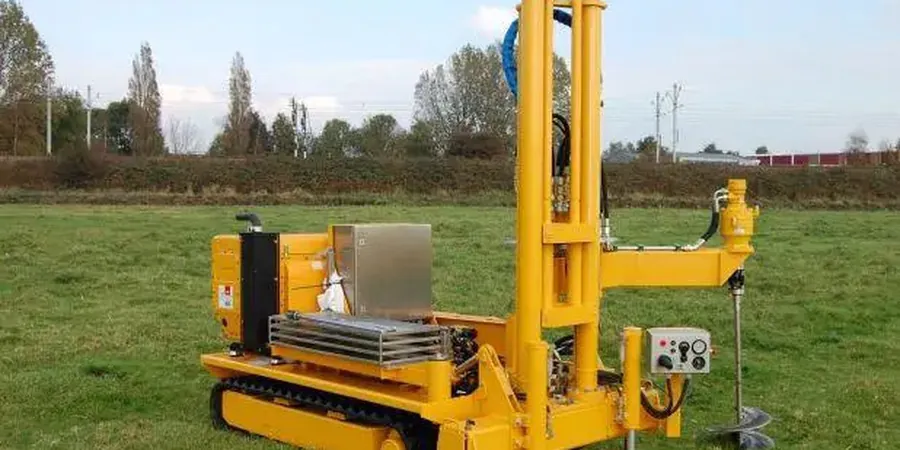
A single CPT sounding can replace three SPT borings in heterogeneous alluvium, reducing project risk and field time simultaneously.
Methodology applied in Corona California
Typical technical challenges in Corona California
Corona's semi-arid climate, with less than 13 inches of rain annually, means the water table is often deep — but after wet winters, the shallow alluvium can become saturated quickly. The risk is that a dry-season CPT profile underestimates pore pressures that will appear during construction. We mitigate this by running dissipation tests at key depths, measuring how fast pore pressure decays to hydrostatic conditions. If the soil is fine-grained and dissipates slowly, that signals potential consolidation settlement under load. Missing this step can lead to differential settlement in structures along the 15/91 interchange corridors, where traffic vibrations add cyclic stress to already saturated silts.
Our services
Beyond the standard CPT push, we offer three specialized applications tailored to Corona's varied geology:
Seismic CPT (SCPT)
A geophone is mounted behind the cone to measure shear wave velocity (Vs) at 1-meter intervals, providing site class data per ASCE 7 for seismic design in Corona's moderate-to-high hazard zone.
Environmental CPT with groundwater sampling
Used near former industrial sites along the 91 corridor to delineate contaminant plumes in shallow alluvium; the cone's pore pressure sensor identifies preferential flow paths.
CPT for liquefaction assessment
Targeted pushes at depths of 5–20 m in loose sand layers, with dissipation tests to estimate cyclic resistance ratio (CRR) and factor of safety against liquefaction under Mw 6.5–7.0 events.
Frequently asked questions
How does CPT differ from SPT in Corona's alluvial soils?
CPT provides a continuous profile of tip resistance and sleeve friction every 2 cm, while SPT gives discrete blow counts at 1.5-foot intervals. In Corona's heterogeneous alluvium, CPT reveals thin loose layers or cemented zones that SPT can miss entirely, making it more reliable for foundation design in variable ground.
What is the typical cost range for a CPT sounding in Corona?
A standard 20 m CPT sounding with dissipation tests runs between US$160 and US$260 per location, depending on access conditions, depth, and the number of pore pressure readings. Mobilization is additional and varies with distance from our yard.
At what depths is CPT most effective in Corona's geology?
CPT is most effective from 3 m to 25 m depth in Corona, where alluvial sands, silts, and clayey layers dominate. Below 25 m, dense older terrace deposits or gravelly layers can cause refusal (tip resistance > 50 MPa), requiring pre-drilling or switching to SPT.
Can CPT data be used for seismic site classification in Corona?
Yes, seismic CPT (SCPT) measures shear wave velocity directly, giving site class per ASCE 7-22. For Corona, where the USGS maps show a 0.4–0.6g peak ground acceleration for a 2% in 50-year event, CPT-based Vs profiles are essential for determining Site Class C or D and designing foundations accordingly.