Walking a site near the Santa Ana River wash, you hit clean sands and gravels; head up into the hills around Eagle Glen and you find clayey silts with cobbles. That contrast defines Corona California’s soil profile. A proper grain size analysis tells us exactly how much sand, silt, and clay is in each layer, which directly affects compaction specs and drainage design. Before we run the hydrometer on fines, we often pair this with a suelos expansivos assessment to flag shrink-swell risk in the deeper clays. For sites near the 91 freeway corridor, we also review capacidad de carga data to correlate particle distribution with bearing capacity. The sieve portion catches everything above 75 microns; the hydrometer takes over below that. Together they give us the full curve.
The hydrometer curve catches particles down to 0.5 microns, which is critical for identifying collapsible or expansive clays in Corona’s alluvial fans.
Methodology applied in Corona California
- Oven drying the sample at 110°C and breaking down clods with a rubber-tipped pestle
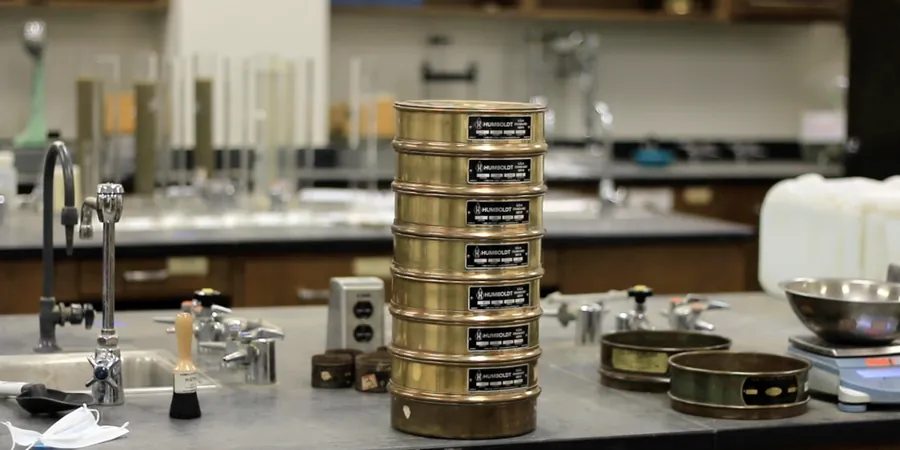
- Stacking sieves from 3-inch down to No. 200 and shaking for 10 minutes
- For the hydrometer, dispersing fines in sodium hexametaphosphate and taking readings at 0.5, 1, 2, 4, 8, 15, 30, 60, 120, and 1440 minutes
- Correcting for temperature and meniscus, then plotting the cumulative percent passing
Typical technical challenges in Corona California
One thing we see often in Corona California is that builders assume the soils are uniform across a lot. They are not. The alluvial fans from the Santa Ana Mountains drop cobbles in one corner and silt in another. If you skip the grain size analysis and rely on a visual estimate, you risk using the wrong compaction method or specifying a too-coarse filter for drainage. In the clay-rich areas near Dos Lagos, the hydrometer portion is essential because the fines can be active and cause pavement heave. A complete particle size distribution catches these variations before they become claims.
Our services
Beyond the basic gradation curve, we offer complementary services that add context to the grain size data:
Combined Sieve and Hydrometer Report
Full particle size distribution from 3-inch down to 0.5 microns, plotted on semi-log paper with D10, D30, D60, Cu and Cc calculated. Includes the hydrometer correction curve and a written interpretation for your Corona California site.
Gradation for Filter Design
When you need to design a granular filter for drainage or a retaining wall backfill, we run the full sieve and hydrometer analysis and apply the Terzaghi filter criteria. This service is common for projects near Temescal Creek.
Frequently asked questions
How much does a grain size analysis cost in Corona California?
A standard sieve and hydrometer analysis typically runs between $100 and $190 per sample. The exact price depends on the number of samples and whether you need the hydrometer portion or just the sieve. We can give you a firm quote once we know the scope.
What is the difference between sieve and hydrometer analysis?
The sieve analysis separates particles larger than 75 microns (No. 200 sieve). The hydrometer analysis measures particles between 75 and 0.5 microns by letting them settle in a water column and timing the sedimentation. Both are needed for a complete gradation curve, especially when dealing with silts and clays common in Corona’s alluvial soils.
How long does the analysis take?
The sieve portion takes about one day. The hydrometer requires readings spread over 24 hours, so we typically deliver the full report in 3 working days. If you have a tight deadline, we can expedite the hydrometer readings by taking only the key time intervals.
Do I need a hydrometer analysis if my soil is sandy?
Not always, but we recommend it when the soil has more than 12% passing the No. 200 sieve. In Corona California, many alluvial fans have a significant fine fraction that shows up only in the hydrometer. If that fines fraction is active clay, it can affect compaction and pavement performance, so the extra test is usually worth it.